
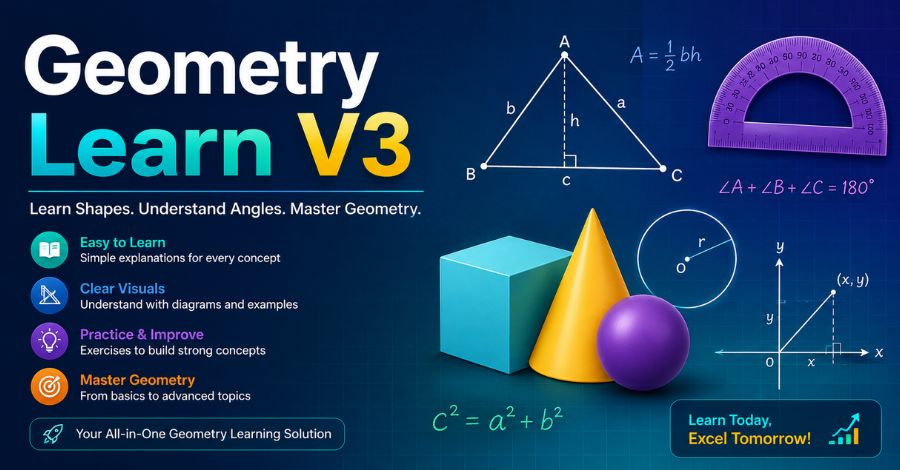
Geometry Learn V3: Your Easy Way to Understand Shapes and Angles (Complete Guide 2026)
ver looked at a bridge and wondered why it’s covered in triangles? Or noticed that honeycombs never use squares? That’s geometry quietly running the show. And with Geometry Learn V3, you stop guessing your way through formulas and start actually seeing why shapes behave the way they do.
Here’s the thing: most people learn geometry backwards. They memorize rules first and understanding never shows up. Flip that order, and everything clicks faster. Once you notice the spatial reasoning hiding in roads, buildings, sports fields, and even your phone screen, you honestly can’t unsee it.
“Geometry is the language of space. Once you understand it, the world becomes easier to read.”
Let’s break it down, piece by piece.
What Geometry Learn V3 Actually Helps You Understand
Forget rote memorization for a second. Geometry Learn V3 builds real visual thinking, the kind where you don’t just solve a problem, you actually get why it works.
That distinction matters more than it sounds like it does. Bridges use triangles because triangles distribute force evenly across every joint. That’s not some abstract theory sitting in a textbook, that’s applied geometry holding up thousands of pounds of steel every single day.
So what does geometry actually give you? It hands you the tools to understand shape and space, measure distance and angles, predict how strong a structure will be, and spot patterns in the world around you. Instead of diving headfirst into formulas, this approach starts with shapes you can see, angles you can measure, and patterns you can recognize with your own eyes.
That’s why it feels faster and a lot less stressful. Along the way, you sharpen four key skills: visual reasoning, logical thinking, measurement accuracy, and good old spatial awareness.
Geometry Basics You Must Master First
Before jumping into anything advanced, you need the foundation nailed down. Skip this part, and everything later on gets shakier.
Points, Lines, and Planes
A point marks a location, nothing more. It has no size at all, think of a dot on a map, a star in a sky chart, or even GPS coordinates, which all start as points. From there, you get lines, which stretch infinitely in both directions (picture a horizon), line segments, which have a fixed start and end (like a table edge), and rays, which start at one point and run forever, the way a beam of sunlight does.
| Concept | Meaning | Example |
| Line | Infinite length, both directions | Horizon line |
| Line segment | Fixed start and end | Table edge |
| Ray | Starts at one point, extends forever | Sunlight beam |
A plane is simply a flat surface with zero thickness: a sheet of paper, a wall, a tablet screen. Once these basics settle in, advanced topics stop feeling intimidating, because literally everything in geometry traces back to them.
Understanding Shapes and Angles Step by Step
Shapes and angles sit right at the heart of geometry, so let’s get specific.
An angle forms the moment two lines meet at a point.
You see them constantly: a door swinging open, scissors snipping paper, clock hands ticking past noon. Angles come in five flavors: acute (under 90°), right (exactly 90°), obtuse (between 90° and 180°), straight (180°), and reflex (anything past 180°
Read More About: Stay Updated Always TXEPC: Complete 2026 Guide to Critical Software Updates
| Type | Measure |
| Acute | Less than 90° |
| Right | Exactly 90° |
| Obtuse | 90° to 180° |
| Straight | 180° |
| Reflex | More than 180° |
You measure angles with a protractor: place the center point on the vertex, align the base line, then read the degrees. But honestly? Understanding comes before measuring.
Skateboard ramps use acute angles, building corners rely on right angles, and open doors create obtuse ones geometry’s been sitting in plain sight this whole time.
Angle Relationships That Make Geometry Easier
Learn how angles relate to each other, and suddenly geometry stops feeling random.
Complementary angles add up to 90°, think 30° plus 60°. Geometry Learn V3 Architects and designers lean on this constantly for layout work. Supplementary angles add up to 180°, like 110° and 70° sitting together on a straight line.
Adjacent angles share a vertex and a side, kind of like pizza slices sitting next to each other on a plate. And here’s a rule worth remembering: vertical angles, the ones formed opposite each other when two lines cross, are always equal. No exceptions. It’s one of the sturdiest rules in the whole subject.
Parallel Lines and Angle Patterns
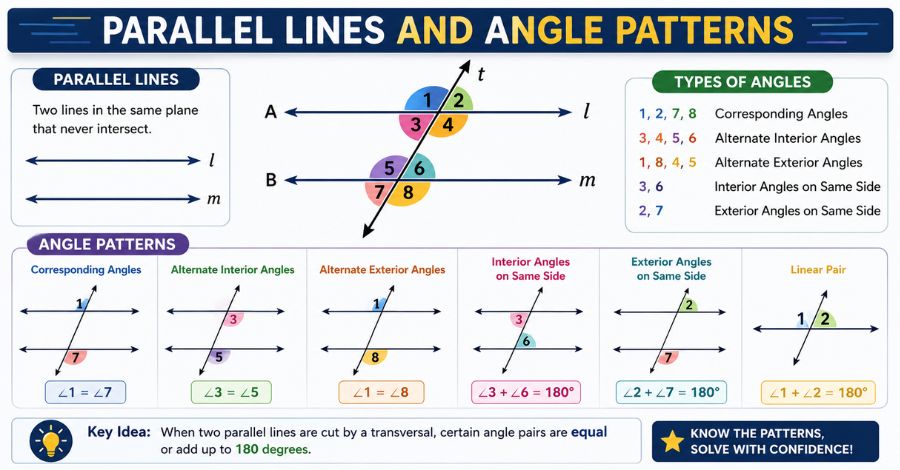
Parallel lines never meet, which sounds almost too simple to matter, yet it creates some genuinely powerful patterns. When a transversal slices through parallel lines, alternate angles match, corresponding angles line up, and interior angles add up to predictable totals.
You’ll spot these patterns everywhere once you know what to look for: railway tracks running side by side, road markings, window frames. Geometry Learn V3 trains your eye to catch these instantly, almost like a reflex.
Polygons and Their Core Properties
A polygon is just a closed shape built from straight sides, nothing fancier than that. Triangles have three sides, quadrilaterals have four, pentagons five, hexagons six, and so on.
| Type | Meaning |
| Regular | Equal sides and angles |
| Irregular | Unequal sides or angles |
Ever wonder why honeycombs use hexagons instead of, say, squares or circles? Geometry Learn V3 Hexagons pack together with zero wasted space, which makes them the most efficient shape bees could’ve picked.
Triangles Explained in a Simple System
Engineers genuinely love triangles, and for good reason they’re the strongest shape geometry has to offer.
By side length, you’ve got equilateral (all sides equal), isosceles (two sides equal), and scalene (no sides match). By angle, there’s the right triangle (one 90° angle), the acute triangle (every angle under 90°), and the obtuse triangle (one angle over 90°).
No matter which type you’re looking at, one rule never breaks: every triangle’s angles add up to exactly 180°.
Roof designs lean on this. So do bridges and mountain-slope calculations. Take the Eiffel Tower, for instance its triangular framework lets it shrug off wind pressure that would flatten a weaker design.
Quadrilaterals and Their Everyday Use
A square has all equal sides, while a rectangle keeps its opposite sides equal instead.
A parallelogram has opposite sides running parallel, which is exactly why sliding doors and certain mechanical systems use that shape.
A rhombus has equal sides but mismatched angles, and a trapezoid has just one pair of parallel sides; you’ll find that shape holding up bridge supports and shaping plenty of furniture designs.
Circles Made Simple
Circles are curves with zero corners, which honestly makes them one of the most elegant shapes out there. The radius runs from center to edge, the diameter cuts straight across, the circumference wraps the outer boundary, an arc is a piece of that boundary, and a sector is a slice of the whole circle, like a wedge cut from a pie.
Two formulas do all the heavy lifting:
- Circumference = 2πr
- Area = πr²
Wheels, coins, and clock circles run the show in more places than you’d think.
Read More About: Playing Games Blog Play Battle Square: The Ultimate Guide to Gaming Tips, Minecraft, and Performance (2026)
Perimeter, Area, and Measurement Basics
The perimeter measures the distance around a shape, like a fence wrapped around a field.
The area measures the space inside it, like carpet covering a floor. Students mix these up constantly, so here’s a quick fix: perimeter uses units like cm or m, while area uses squared units like cm² or m². Keep that distinction straight and you’ll dodge one of geometry’s most common slip-ups.
Symmetry, Congruence, and Similarity
Symmetry happens when a shape matches itself after folding butterfly wings and human faces both show this off. Rotational symmetry means a shape looks identical after spinning it partway around. Geometry Learn V3 Congruent shapes share the exact same size and shape, while similar shapes share the same shape but differ in size maps and architectural scaling both depend heavily on that last idea.
Geometry in Nature and Real Life
Nature doesn’t just use geometry occasionally, it leans on it constantly. Snowflakes show off hexagonal symmetry. Sunflowers arrange their seeds in spiral patterns that follow the Fibonacci sequence, which packs seeds together with remarkable efficiency.
Spider webs radiate outward in near-perfect symmetry, and tree rings grow in circles that record years like a timestamp.
Real-World Uses of Geometry Learn V3
| Field | Application |
| Architecture | Building design |
| Engineering | Structural safety |
| Navigation | GPS mapping |
| Sports | Trajectory angles |
| Design | Layout balance |
| Animation | 3D modeling |
How to Learn Geometry Faster
Want results without burning out? Draw everything you learn instead of just reading about it.
Grab real objects and study their angles. Learn patterns before formulas. Practice for fifteen minutes daily rather than cramming for hours. And try teaching someone else what you just picked up explaining a concept out loud has a funny way of cementing it in your own head.
Common Mistakes in Geometry
Misreading angle diagrams trips up more students than almost anything else.
People also mix up parallel and perpendicular lines, forget their units, assume every diagram is drawn to scale (it usually isn’t), and confuse similar shapes with congruent ones. Dodge these five traps, and your accuracy jumps almost overnight.
Practice Guide
A simple daily routine works wonders: five minutes drawing shapes, five minutes practicing angles, five minutes solving problems. Consistency wins here, not marathon study sessions that leave you drained by the end.
Read More About:45 Tubefalire Explained: What This Word Actually Is (And Why So Many Sites Define It Differently)
Quick Reference Sheet
| Concept | Key Rule |
| Triangle angles | 180° |
| Straight line | 180° |
| Full circle | 360° |
| Right angle | 90° |
Why Geometry Skills Improve Over Time
Your brain gets better at spotting patterns the more it practices, plain and simple. Over time, you’ll recognize shapes faster, calculate quicker, and make fewer careless mistakes. Geometry Learn V3 simply gives that natural growth a clear structure to follow.
FAQ,s
What’s the fastest way to learn angles? Practice with everyday objects like clocks and doors you’ll start spotting angles everywhere within days.
Why do triangles equal 180°? It comes down to how parallel lines interact inside a triangle’s structure.
How do you quickly identify shapes? Count the sides, then check the angles. That combo tells you almost everything you need.
Do circles have angles? Not in the traditional sense, no but they do have curved measurements, like arcs and sectors.
Is geometry only flat shapes? Not at all. It covers 3D shapes too, from cubes to spheres and beyond.
Why are parallel lines important? Because they create angle patterns you can predict every single time, which makes design and construction work far more reliable.
Final Thoughts
Geometry Learn V3 makes the whole subject click by focusing on understanding instead of memorization. Once patterns start jumping out at you, shapes and angles stop feeling random and start feeling familiar. You’ll notice geometry in roads, buildings, nature, even the arc of a basketball shot because it’s all running on the same rules underneath.
Master the basics first. Everything else builds naturally from there.