
I’m Pregnant. Are Nivea Products Safe Compared to Burt’s Bees or Mustela? (2026 Guide)
You just found out you’re pregnant. Your bathroom shelf suddenly looks different. That jar of Nivea you’ve used for years now feels like a question mark. So does your favorite Burt’s Bees lip balm. And maybe a friend just told you to try Mustela. So you type one simple question into Google: is Nivea safe during pregnancy, or should you switch brands completely?
This guide answers that question in full. I’m Pregnant. Are Nivea Products Safe Compared to Burt’s Bees or Mustela? We compare Nivea, Burt’s Bees, and Mustela side by side. We look at the actual ingredients, not just the brand names. And we explain, in plain and easy English, what pregnancy-safe skincare really means in 2026.
Quick Verdict
Let’s start with the short answer, because you’re busy and your feet probably hurt. Mustela is built from the ground up for pregnant and postpartum skin. Almost every product in its Mustela Maternity line skips the ingredients doctors worry about most. Nivea is safe in its simple, everyday products. Think Nivea Creme pregnancy use, or Nivea Soft pregnancy use, both fine for most expecting moms. But its anti-aging and brightening lines need a closer look. Burt’s Bees leans on natural branding, and the Burt’s Bees Mama Bee line was made just for pregnancy. Still, natural does not always mean safe, so a few products in the wider Burt’s Bees range need checking too.
If you remember only one thing from this article, remember this. Brand names do not decide safety. Ingredients do. A cheap lotion can be perfectly safe. An expensive serum can contain something you should avoid. So the rest of this guide walks you through the ingredients first, then the brands, so you can make your own confident choice.
Why Pregnancy Changes Your Skincare Routine
Pregnancy does not just change your body. It changes your skin, too. Hormones shift fast during these nine months. That shift can make old products feel new again, in a bad way. A cream that never bothered you before might suddenly cause redness or itching. This is completely normal, and it is one reason pregnancy skin sensitivity becomes such a common topic in doctor’s offices.
Your skincare routine also needs a second look because of what enters your bloodstream. Some ingredients absorb through skin more than others. During pregnancy, anything that crosses into your blood can, in theory, reach your baby too. That is why doctors ask pregnant women to pay closer attention to labels, even for everyday products like body lotion or facial moisturizer.
How Pregnancy I’m Pregnant. Are Nivea Products Safe Compared to Burt’s Bees or Mustela? Affects Your Skin
Rising estrogen and progesterone levels change how your skin behaves. Oil production often increases, which can lead to breakouts even if you never had acne before. Pigmentation can shift too, causing dark patches on the face known as melasma. Many women also notice their skin turns drier, itchier, or more reactive than before, especially around the belly as it stretches.
These changes are the reason pregnancy skin health deserves real attention, not guesswork. Your skin is working harder than usual. It needs support, not more irritation from the wrong ingredients.
Why Ingredients Matter More Than Brand Names
Here is a simple truth many people miss. A luxury label does not guarantee safety. A drugstore brand does not guarantee danger. What matters is the ingredient list printed on the back of the bottle. This is true whether you are comparing Nivea vs Burt’s Bees, Burt’s Bees vs Mustela, or Nivea vs Mustela.
Once you understand which ingredients to avoid, you can judge any product from any brand, at any price. That skill matters more than brand loyalty ever will. I’m Pregnant. Are Nivea Products Safe Compared to Burt’s Bees or Mustela? So before we talk about specific brands, let’s cover the ingredients that actually decide safety.
Pregnancy-Safe Skincare Ingredients: What to Look For
Not every ingredient deserves worry. In fact, most everyday moisturizing ingredients are completely fine during pregnancy. Knowing which ones fall into this safe category can save you a lot of unnecessary stress while shopping.
This section breaks safe ingredients into two useful groups. One covers basic moisturizing agents. The other covers ingredients that repair your skin barrier, which becomes especially important as your pregnancy skincare routine shifts to handle new dryness and sensitivity.
Moisturizing Ingredients That Are Generally Considered Safe
Glycerin sits at the top of this list. It draws water into your skin and rarely causes irritation. Shea butter is another safe favorite, rich in fatty acids that soften rough, stretching skin. Mineral oil and petrolatum, both found in classic products like Nivea Creme, form a protective layer on the skin without absorbing deeply into the body. Squalane, a lightweight oil, hydrates without feeling greasy. Hyaluronic acid, often used in a gentle facial moisturizer, holds huge amounts of water in the skin and is considered safe at typical skincare concentrations.
These ingredients are why so many basic body lotions and creams count among the pregnancy-safe moisturizer brands available in most US stores today. You do not need anything exotic. Simple, well-tested ingredients often do the best job.
Barrier-Repair Ingredients
Your skin has a natural barrier that keeps moisture in and irritants out. Pregnancy can weaken that barrier, leading to dryness, itching, and sensitivity. I’m Pregnant. Are Nivea Products Safe Compared to Burt’s Bees or Mustela? This is where skin barrier repair ingredients earn their keep. Ceramides rebuild this barrier directly, since they are a natural part of your skin’s own structure. Niacinamide, used at moderate concentrations, calms redness and supports the barrier without causing harm. Ectoin, a newer ingredient in some higher-end creams, protects skin cells from stress and dehydration.
If your skin feels tight, flaky, or easily irritated these days, look for a daily moisturizing cream built around these barrier-repair ingredients. They tend to work well for sensitive pregnancy skin without adding unnecessary risk.
Read More About:66 I Have Sensitive Skin. How Gentle Are Nivea’s Creams Compared to Aveeno?
Fragrance and Sensitive Skin During Pregnancy
Fragrance often gets a bad reputation, but it is not officially classified as unsafe during pregnancy. The real issue is comfort, not danger. Many pregnant women develop a much sharper sense of smell, and strong scents can trigger nausea or headaches.I’m Pregnant. Are Nivea Products Safe Compared to Burt’s Bees or Mustela? Because of this, fragrance-free skincare becomes a popular choice, not because fragrance is dangerous, but because it is easier on a sensitive nose and sensitive skin.
If you notice your skin reacting to scented products, or if smells make you feel sick more easily, switching to a fragrance-free moisturizer for pregnancy is a simple, low-risk fix. It will not solve every skin concern, but it often makes daily use more pleasant.
Ingredients to Avoid During Pregnancy
Now let’s talk about the ingredients that deserve real caution. This list covers the most common ingredients to avoid during pregnancy, based on advice frequently shared by dermatologists and OB-GYNs. None of these require panic if you have already used them without knowing. But going forward, they are worth checking for on every label.
The table below gives you a fast reference. After it, we explain each ingredient in more detail, so you understand the reasoning behind every entry.
| Ingredient | Why It Raises Concern | Common Advice |
| Retinoids | Linked to birth defects at high oral doses; topical caution advised | Avoid during pregnancy |
| Hydroquinone | Higher skin absorption than most topicals | Avoid during pregnancy |
| High-strength salicylic acid | Leave-on formulas above roughly 2 percent flagged | Use only low-dose, rinse-off versions |
| Chemical sunscreen filters | Oxybenzone linked to hormone concerns in animal studies | Prefer mineral sunscreen instead |
| Certain essential oils | Rosemary, sage, and clary sage flagged, especially in early pregnancy | Use cautiously, ask your provider |
| Parabens, phthalates, triclosan | Ongoing hormone-disruption debate | Many providers suggest limiting exposure |
Retinoids (Vitamin A Derivatives)
Retinoids include retinol, retinoic acid, tretinoin, and retinyl palmitate. These ingredients are common in anti-aging creams and acne treatments. High oral doses of vitamin A derivatives have been linked to birth defects in medical studies. Topical absorption is much lower than oral use, but most dermatologists still recommend avoiding retinoids in skincare entirely during pregnancy, simply out of caution.
If you used a retinol cream before you knew you were pregnant, try not to worry too much. Talk to your doctor at your next visit, and switch to a pregnancy-safe alternative going forward.
Hydroquinone
Hydroquinone is a skin-brightening ingredient often used to treat dark spots or melasma. Studies show it absorbs into the skin at higher rates than many other topical ingredients. Because of this, most obstetricians advise against hydroquinone pregnancy use. If dark patches bother you during pregnancy, safer brightening alternatives exist, including azelaic acid and moderate niacinamide, both worth discussing with your provider.
High-Strength Salicylic Acid
Salicylic acid appears in many acne treatments and exfoliating cleansers. Low concentrations in rinse-off products, generally under 2 percent, are usually considered fine. Salicylic acid pregnancy safety becomes more of a concern with leave-on treatments at higher strengths, since these sit on the skin longer and allow more absorption. If your acne routine relies on a leave-on salicylic acid product, ask your dermatologist about safer daily-use alternatives.
Chemical Sunscreen Filters
Some chemical sunscreen filters, oxybenzone in particular, have raised hormone-disruption questions in animal studies. Human data remains more limited, but many pregnant women choose to avoid chemical sunscreen pregnancy exposure as a simple precaution. I’m Pregnant. Are Nivea Products Safe Compared to Burt’s Bees or Mustela? Mineral sunscreens, built from zinc oxide or titanium dioxide, sit on top of the skin rather than absorbing in, offering solid protection with far less systemic exposure.
Certain Essential Oils
Essential oils sound gentle, but many are highly concentrated plant extracts. Essential oils during pregnancy require more individual caution than most people expect. Rosemary, sage, clary sage, and peppermint oils are commonly flagged, especially during the first trimester, when some midwives and aromatherapists suggest extra care. This area has less firm clinical consensus than ingredients like retinoids, so when in doubt, ask your provider before using a new essential-oil product regularly.
Parabens, Phthalates, and Triclosan
Parabens in skincare act as preservatives, extending shelf life and preventing bacterial growth. Phthalates pregnancy exposure often comes from fragrance formulations, since phthalates can be used to help scent last longer. Triclosan skincare use, mostly found in older antibacterial products, has also drawn hormone-disruption concerns. The science on all three remains debated rather than fully settled, but many providers suggest limiting exposure during pregnancy as a reasonable precaution, especially since paraben-free and phthalate-free alternatives are now widely available.
Nivea During Pregnancy
Nivea has built its reputation on simple, affordable moisturizers that have sat in bathroom cabinets for generations. Most of its core body-care line uses straightforward ingredients like glycerin, mineral oil, and petrolatum, without aggressive activities. I’m Pregnant. Are Nivea Products Safe Compared to Burt’s Bees or Mustela? This makes many everyday Nivea products a safe, budget-friendly part of a pregnancy skincare routine.
That said, Nivea also sells anti-aging and brightening product lines. These sometimes include retinol or other activities that fall into the ingredients-to-avoid category discussed earlier. So while the basics are safe, not every Nivea product on the shelf gets an automatic pass.
Which Nivea Products Are Generally Considered Low Risk?
Classic Nivea Creme pregnancy use, in the familiar blue tin, is considered low risk. Its formula relies on glycerin, mineral oil, petrolatum, and lanolin alcohol, none of which appear on pregnancy caution lists. Nivea Soft pregnancy use is similarly low risk, since it shares a comparable simple, emollient-based formula. Nivea Body Essentially Enriched Lotion also fits this safer category, making it a reasonable choice if you are looking for a straightforward pregnancy-safe body cream.
Pros and Cons of Using Nivea While Pregnant
Nivea’s biggest advantage is accessibility. It sits on shelves in nearly every US pharmacy and grocery store, and it costs far less than specialty maternity brands. Its core formulas are simple enough that checking the label takes only a minute. On the downside, Nivea’s anti-aging and brightening lines can include retinol or retinyl palmitate, so those specific products need a closer look before use. Many Nivea products also use synthetic fragrance, which is not unsafe, but may bother a nose that has become more sensitive during pregnancy.
Burt’s Bees During Pregnancy
Burt’s Bees built its brand around naturally derived ingredients, appealing to shoppers who want plant-based formulas. That branding is popular, but it comes with a catch. Natural ingredients, including essential oils, can still be potent enough to require caution. Not every Burt’s Bees product earns an automatic pregnancy-safe label just because it says “natural” on the front.
Fortunately, the brand also offers a maternity-specific sub-line, making it easier to find genuinely safe options without guessing.
Which Burt’s Bees Products Are Pregnancy Friendly?
The Burt’s Bees Mama Bee collection was designed specifically for pregnancy. Mama Bee Belly Butter and Mama Bee Nourishing Body Oil both skip retinoids, hydroquinone, and high-strength acids, making them solid choices for a pregnancy-safe skincare routine. I’m Pregnant. Are Nivea Products Safe Compared to Burt’s Bees or Mustela? Outside this dedicated line, shoppers should check labels individually, especially on products containing essential oils or the brand’s acne treatment line.
Read More About: I’m a Skincare Beginner. Is Nivea a Good Starting Brand Compared to Garnier? (2026 Guide)
Pros and Cons of Burt’s Bees
Burt’s Bees offers a genuine maternity-focused sub-line, which many other mainstream brands lack. Its naturally derived ingredients appeal to shoppers who prefer plant-based formulas over synthetic ones, and pricing sits comfortably in the mid-range. I’m Pregnant. Are Nivea Products Safe Compared to Burt’s Bees or Mustela? On the downside, some products outside the Mama Bee line include essential oils like rosemary or peppermint, which deserve individual review. The brand’s Natural Acne Solutions line also contains salicylic acid, so daily leave-on use should be discussed with a dermatologist first.
Mustela During Pregnancy
Mustela takes a different approach entirely. Rather than adapting an existing product line for pregnancy, the brand built its business specifically around maternity and newborn skin from the start. This focus shows up clearly in its ingredient choices and testing standards.
Every product in the Mustela Maternity line is formulated with pregnancy-specific safety in mind, avoiding the ingredients most commonly flagged by doctors.
Mustela Products Designed for Pregnancy
The Mustela Stretch Marks Cream stands out as a flagship product, built around water, coco-caprylate, glycerin, and shea butter, along with peptides meant to support skin elasticity as your body changes shape. The brand’s Maternity Body Lotion follows a similar formulation philosophy, skipping retinoids, parabens, phthalates, and phenoxyethanol entirely. Many Mustela products also come in fragrance-free versions, appealing to shoppers looking for a true fragrance-free moisturizer for pregnancy.
Pros and Cons of Mustela
Mustela’s biggest strength is intentional design. I’m Pregnant. Are Nivea Products Safe Compared to Burt’s Bees or Mustela? Every product in its maternity range was built for pregnant and postpartum skin from day one, and many carry hypoallergenic labeling backed by dermatological testing. This makes Mustela a strong choice among dermatologist-approved skincare options for pregnancy. I’m Pregnant. Are Nivea Products Safe Compared to Burt’s Bees or Mustela? The downside is price. Mustela typically costs more than Nivea or Burt’s Bees, and it is not always sold in standard US grocery stores, sometimes requiring a trip to a specialty retailer or pharmacy section.
Nivea vs. Burt’s Bees vs. Mustela: Ingredient Comparison
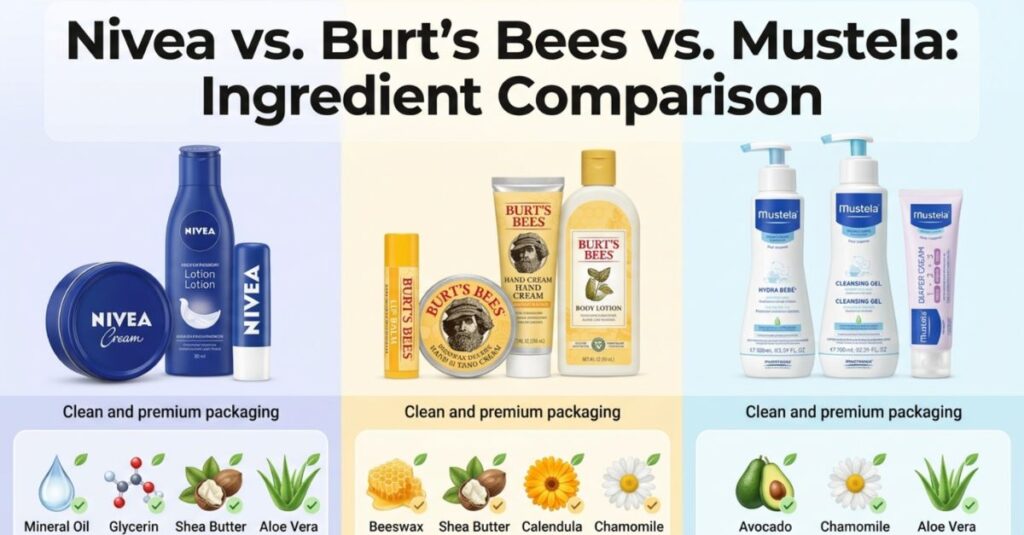
Comparing these three brands side by side makes the differences much clearer. This skincare comparison looks at four key categories that matter most during pregnancy: fragrance, preservatives, plant-based ingredients, and hydration support.
Fragrance
Nivea commonly uses synthetic fragrance across its core line. Burt’s Bees often relies on natural fragrance from essential oils and plant extracts. Mustela leans toward fragrance-free formulations, especially within its dedicated maternity products, making it the easiest choice for anyone highly sensitive to scent right now.
Preservatives
Nivea includes parabens in some of its formulas, though not all. Burt’s Bees generally avoids parabens across its range. Mustela also formulated without parabens, phthalates, or phenoxyethanol in its maternity line, giving it the cleanest preservative profile of the three brands.
Plant-Based Ingredients
Burt’s Bees leans most heavily on plant-based and naturally derived ingredients, true to its branding. Nivea uses fewer botanical extracts, relying instead on classic emollients like mineral oil and petrolatum. I’m Pregnant. Are Nivea Products Safe Compared to Burt’s Bees or Mustela? Mustela sits in between, using shea butter and plant oils, but pairs them with lab-tested peptides rather than leaning fully into a “natural” identity.
Hydration and Skin Barrier Support
All three brands offer solid hydration, but through different routes. Nivea’s core strength is simple, reliable moisture using glycerin and petrolatum. I’m Pregnant. Are Nivea Products Safe Compared to Burt’s Bees or Mustela? Burt’s Bees ads beeswax and botanical oils for a slightly richer texture. Mustela focuses on skin barrier repair through peptides and specialized emollients, aiming at pregnancy-specific concerns like elasticity and stretch-related dryness.
Comparison Table: Nivea vs. Burt’s Bees vs. Mustela
The table below summarizes everything covered so far, giving you one clear reference point for comparing all three brands at a glance.
| Category | Nivea | Burt’s Bees | Mustela |
| Ingredients | Glycerin, mineral oil, petrolatum; some lines contain retinol | Shea butter, beeswax, plant oils; Mama Bee line avoids harsh actives | Shea butter, peptides, coco-caprylate; formulated without retinoids or parabens |
| Pregnancy Safety | Core line safe; check anti-aging/brightening lines | Mama Bee line safe; check essential-oil and acne products | Entire maternity line built for pregnancy safety |
| Best For | Budget-friendly daily basics | Naturally derived preference, mid-range pricing | Pregnancy-specific formulation, sensitive skin |
| Price Range | Budget (low cost, widely available) | Mid-range | Premium |
Best Brand for Common Pregnancy Skin Concerns
Different skin concerns call for different products, regardless of brand loyalty. I’m Pregnant. Are Nivea Products Safe Compared to Burt’s Bees or Mustela? This section matches common pregnancy skin issues with the brand and product type most likely to help.
Stretch Marks
Mustela’s stretch-mark-focused line, built around peptides and shea butter, targets elasticity directly, making it a strong pick for pregnancy stretch mark care. I’m Pregnant. Are Nivea Products Safe Compared to Burt’s Bees or Mustela? Burt’s Bees Mama Bee Belly Butter offers a naturally derived alternative at a lower price. Nivea’s basic body lotion works as a simple, budget-friendly option for daily moisture, though it is not specifically formulated for stretch marks.
Dry Skin
For general dryness, richer emollients tend to work best. Burt’s Bees products containing shea butter and beeswax often feel more nourishing for very dry skin. Nivea Creme, thanks to its petrolatum base, also performs well as a pregnancy-safe body cream for dry patches. Mustela’s Maternity Body Lotion ads barrier-repair ingredients on top of basic hydration, useful if dryness comes with noticeable sensitivity.
Sensitive Skin
Mustela generally leads here, thanks to hypoallergenic testing and fragrance-free options built for sensitive pregnancy skin. Nivea’s core, fragrance-light formulas can also work well for sensitive skin, as long as you avoid its more heavily scented lines. Burt’s Bees requires more label-reading in this category, since essential oils can sometimes trigger reactions in reactive skin.
Itchy Belly
An itchy, stretching belly usually responds best to barrier-repair ingredients combined with rich hydration. Mustela’s stretch-mark formulas target this directly. Burt’s Bees Belly Butter, despite the playful name, is genuinely formulated with this exact concern in mind. I’m Pregnant. Are Nivea Products Safe Compared to Burt’s Bees or Mustela? Nivea’s basic body lotion can help too, though it focuses more on general hydration than targeted barrier repair.
Read More About: TheLifestyleEdge com Review (2026): Honest Verdict – Is This Lifestyle Platform Worth Your Time?
Hormonal Skin Changes
Pregnancy hormones often cause breakouts or dark patches, known as melasma. Since retinoids and hydroquinone are both off the table during pregnancy, safer alternatives matter here. Niacinamide, found in moderate concentrations across all three brands’ broader ranges, offers a gentler brightening option. Azelaic acid, though not always found in mainstream drugstore products, is another dermatologist-recommended alternative worth discussing with your provider.
Can You Use These Products While Breastfeeding?
Many of the same safety rules that apply during pregnancy continue after birth, especially if you are breastfeeding. Breastfeeding-safe skincare products generally avoid the same ingredients flagged during pregnancy, plus a few extra considerations specific to nursing.
Ingredients to Continue Avoiding
Retinoids and hydroquinone remain on the avoid list while breastfeeding, following similar reasoning about systemic absorption. High-strength salicylic acid and certain essential oils also deserve continued caution. I’m Pregnant. Are Nivea Products Safe Compared to Burt’s Bees or Mustela? If you plan to resume any treatment products after birth, check with your doctor about timing, especially if you are nursing frequently.
Nipple Cream Safety
Nipple creams deserve special attention, since anything applied there can transfer directly to your baby during feeding. Lanolin-based creams are commonly recommended and considered safe, but many providers suggest wiping off any residue before your baby latches, just as an extra precaution. I’m Pregnant. Are Nivea Products Safe Compared to Burt’s Bees or Mustela? Fragrance-free formulas are generally preferred in this specific area, since babies can be sensitive to strong scents up close.
How to Check Whether Any Skincare Product Is Pregnancy Safe
You do not need to memorize every ingredient name. A simple system makes checking any product fast and reliable, whether it is from Nivea, Burt’s Bees, Mustela, or any other brand entirely.
Read the Ingredient List
Start by scanning for the ingredients covered earlier in this guide: retinoids, hydroquinone, high-strength salicylic acid, chemical sunscreen filters, certain essential oils, parabens, phthalates, and triclosan. If none of these appear near the top of the ingredient list, the product is very likely safe for everyday use.
Use Ingredient Safety Databases
Several online tools let you search a specific product and see a safety breakdown instantly. Databases like EWG Skin Deep and INCIDecoder are commonly used for this purpose. These tools help answer how to check if skincare is pregnancy safe for products not covered directly in this article.
Ask Your Healthcare Provider
For anything treatment-related, like acne medication or a prescription cream, your OB-GYN or dermatologist should always have the final say. General guides like this one offer solid background knowledge, but personal medical history can change what is right for you specifically. This is especially true for dermatologist recommended pregnancy skincare involving active treatments rather than basic moisturizers.
How to Choose Between Nivea, Burt’s Bees, and Mustela
At this point, you understand the ingredients and the brands. I’m Pregnant. Are Nivea Products Safe Compared to Burt’s Bees or Mustela? Now it comes down to matching your priorities to the right choice.
Choose Nivea If…
You want an affordable, no-frills option and do not mind reading labels carefully before buying anti-aging or brightening products. Nivea’s core line remains one of the most accessible pregnancy-safe moisturizer brands on the market, especially for daily body and hand cream needs.
Choose Burt’s Bees If…
You prefer naturally derived ingredients and want a dedicated maternity sub-line without paying premium prices. Just remember to check individual products outside the Mama Bee collection, since not everything in the wider Burt’s Bees range is automatically pregnancy-safe.
Choose Mustela If…
You want products built specifically for pregnancy from the ground up, and you are comfortable paying more for that focus. Mustela remains one of the strongest choices among dermatologist-approved skincare options, particularly for sensitive or reactive skin.
Pros and Cons at a Glance
| Brand | Main Strength | Main Limitation |
| Nivea | Affordable, widely available, simple core formulas | Anti-aging lines may contain retinol |
| Burt’s Bees | Naturally derived, dedicated Mama Bee maternity line | Some essential oils and acne products need checking |
| Mustela | Purpose-built for pregnancy, hypoallergenic testing | Higher price, less common in standard grocery stores |
Frequently Asked Questions
Is Nivea Creme safe during pregnancy?
Yes. Nivea Creme uses glycerin, mineral oil, petrolatum, and lanolin alcohol. I’m Pregnant. Are Nivea Products Safe Compared to Burt’s Bees or Mustela? None of these ingredients appear on pregnancy caution lists, making it a reliable, simple option.
Are all Burt’s Bees products pregnancy safe?
No, not automatically. The Mama Bee line was designed specifically for pregnancy. Other Burt’s Bees products may contain essential oils or salicylic acid, so check labels individually rather than assuming brand-wide safety.
Is Mustela worth the higher price?
For many expecting mothers, yes. Mustela’s entire maternity line was formulated specifically for pregnancy safety, backed by dermatological testing. Whether it is “worth it” depends on your personal budget and priorities.
Can I switch between these brands during pregnancy?
Yes. There is no medical reason to stick with just one brand. I’m Pregnant. Are Nivea Products Safe Compared to Burt’s Bees or Mustela? Many women mix and match, using an affordable Nivea body lotion daily while choosing Mustela for a targeted stretch-mark cream, for example.
Should I avoid fragrance while pregnant?
Not necessarily. Fragrance is not classified as unsafe during pregnancy. However, if strong scents cause nausea or skin irritation, a fragrance-free moisturizer for pregnancy may feel more comfortable day to day.
Which skincare ingredients should I avoid during pregnancy?
The main ones include retinoids, hydroquinone, high-strength salicylic acid, chemical sunscreen filters like oxybenzone, certain essential oils, and preservatives like parabens, phthalates, and triclosan.
Does natural always mean safer?
No. Natural ingredients, including essential oils, can still be potent enough to cause irritation or require caution during pregnancy. Always check the specific ingredient, not just the natural branding on the label.
Should I stop using skincare after finding out I’m pregnant?
No. Most everyday moisturizers remain completely safe. The goal is simply to review your routine, checking especially for retinoids, hydroquinone, and other ingredients covered in this guide.
Can I use Nivea products while breastfeeding?
Generally, yes, for the core moisturizing line. The same caution around retinoids and other flagged ingredients continues to apply after birth, especially for products used near the nursing area.
Should I ask my OB-GYN before changing skincare products?
For basic moisturizers, it is usually not necessary. For anything treatment-related, like acne medication or prescription creams, checking with your OB-GYN or dermatologist is always the safest choice.
conclusion
There is no single winner that fits every expecting mother. If budget matters most and you are comfortable reading labels, Nivea delivers reliable, affordable basics. I’m Pregnant. Are Nivea Products Safe Compared to Burt’s Bees or Mustela? If you prefer naturally derived ingredients and want a dedicated maternity option without a premium price tag, Burt’s Bees and its Mama Bee line fit well. If you want products engineered specifically for pregnancy safety, backed by dermatological testing, Mustela stands out as the most purpose-built choice among these three.
Whichever brand you choose, the real skill lies in reading ingredient lists, not chasing brand reputation. I’m Pregnant. Are Nivea Products Safe Compared to Burt’s Bees or Mustela? That single habit will serve you well throughout pregnancy, breastfeeding, and beyond.