

Sciatica Pain Relief in 10 Minutes: 12 Fast Exercises and Stretches That Actually Work
Sciatica can stop your whole day in its tracks. One wrong move and pain shoots down your leg. You need sciatica pain relief in 10 minutes, not next week. Sciatica Pain Relief in 10 Minutes: 12 Fast Exercises and Stretches That Actually Work The good news is that fast relief for sciatic nerve pain is possible. This guide shows you how to get rid of sciatica naturally, using simple moves you can do at home.
This article covers the best exercises for sciatica, why they work, and how to build them into your day. You’ll also learn sciatica home treatment tips, daily habits, and warning signs that mean it’s time to call a doctor. Let’s start with a quick answer.
Quick Answer: Can You Relieve Sciatica in Just 10 Minutes?
Yes, you can often ease pain fast. Gentle stretches that relieve sciatica loosen tight muscles around the nerve. This eases pressure and calms sciatic nerve inflammation within minutes for many people. A short routine won’t cure the root cause, but it can bring real, quick comfort.
Results depend on what’s causing your pain. Mild cases from tight muscles respond well to movement. Severe nerve compression from a disc problem may need more than stretching. Either way, a 10-minute sciatica workout is a smart first step before trying anything else.
What Is Sciatica?
Sciatica is not a disease. It’s a symptom. It happens when something irritates or presses on the sciatic nerve, the longest nerve in your body. Sciatica Pain Relief in 10 Minutes: 12 Fast Exercises and Stretches That Actually Work This nerve runs from your lumbar spine through your hip and down each leg. When it gets squeezed, pain travels along its path.
Most people only feel it on one side. The pain can be mild, or it can be sharp and severe. Understanding what causes sciatic nerve pain helps you pick the right relief method. Below, we break down the causes, symptoms, and who faces the highest risk.
What Causes Sciatic Nerve Pain?
A few common problems lead to a pinched sciatic nerve. A herniated disc, also called a slipped disc, is the top cause. The soft inner part of a spinal disc pushes out and presses on nearby nerves. This creates spinal nerve irritation that radiates down the leg.
Spinal stenosis is another cause. This is a narrowing of the space around your spinal cord. Degenerative disc disease wears down the cushioning discs over time, raising the risk of nerve contact. Piriformis syndrome is different. Here, a small muscle in your buttock tightens and irritates the nerve directly, without any disc problem at all. Pregnancy, extra body weight, and old injuries can all add pressure too. Doctors often call this whole pattern lumbar radiculopathy.
Common Symptoms of Sciatica
The most common sign is pain that runs from your lower back into your buttock and down one leg. Sciatica Pain Relief in 10 Minutes: 12 Fast Exercises and Stretches That Actually Work This is different from plain lower back pain, which stays in one spot. Sciatica travels.
You might also feel numbness, tingling, or a burning feeling. Some people describe it as pins and needles in the foot. Others feel sudden leg pain relief attacks disappear, then return without warning. Sciatica Pain Relief in 10 Minutes: 12 Fast Exercises and Stretches That Actually Work Muscle weakness in the leg or foot is a serious sign and should not be ignored. Sitting for long periods, coughing, or sneezing often makes the pain worse.
Who Is Most at Risk?
Age plays a big role. Most cases show up between ages 40 and 60, as spinal discs naturally wear down. People with desk jobs face higher risk too, since sitting all day adds pressure to the lower spine.
Physical jobs carry their own risk. Heavy lifting and twisting strain the back and can trigger a flare-up. Extra body weight adds constant stress on the spine. Diabetes can damage nerves over time, making sciatica more likely. Pregnant women often develop sciatica in later months, as the growing uterus presses on nearby nerves. Prior back injuries also raise your odds of a repeat episode.
Can a 10-Minute Routine Really Help Sciatica?
Movement changes how your nerve feels. Gentle stretching increases blood flow to tight muscles. This eases tension around the compressed sciatic nerve and can bring noticeable relief in a short time. Many physical therapists recommend movement over rest, since staying still often makes muscles tighter.
That said, a short routine is not magic. It works best for mild to moderate pain. Severe or long-lasting cases need a full evaluation. Sciatica Pain Relief in 10 Minutes: 12 Fast Exercises and Stretches That Actually Work Think of these exercises as first aid, not a permanent fix, though they still form the backbone of most rehabilitation program plans.
When Fast Relief Is Possible
Fast relief usually comes when tight muscles are the main problem. Piriformis syndrome, for example, often responds well to targeted stretching within days. Poor posture from long sitting sessions also tends to ease quickly once you start moving again.
Early flare-ups respond better than chronic ones. If you catch the pain early and start gentle movement right away, you often avoid it getting worse. Waiting too long lets muscles tighten further and can turn a short episode into a long one.
When You Should See a Doctor
Some signs mean home care isn’t enough. If pain lasts more than a few weeks despite trying stretches, see a doctor. Growing weakness or numbness in your leg or foot is also a red flag worth checking out.
Loss of bladder or bowel control is a medical emergency. This rare symptom, called cauda equina syndrome, needs immediate care. Pain after a fall or accident, or pain in both legs at once, also calls for a proper medical exam rather than home treatment alone.
Best Sciatica Relief Exercises You Can Do in 10 Minutes
These moves make up a full 10-minute sciatica workout. You can do them all together or pick a few based on your symptoms. Go slowly, and stop any move that sharply increases your pain. This routine works well as home exercises for nerve pain and fits into any busy day.
Pelvic Tilts
Lie on your back with knees bent and feet flat on the floor. Tighten your stomach muscles and flatten your lower back against the floor. Hold for five seconds, then release. The pelvic tilt exercise gently wakes up your core and reduces stiffness in your lower spine. Repeat this ten to fifteen times.
This move is often the first step in any lower back stretching routine.Sciatica Pain Relief in 10 Minutes: 12 Fast Exercises and Stretches That Actually Work It’s safe for almost everyone and prepares your spine for the deeper stretches that follow.
Cat-Cow Stretch
Get on your hands and knees. Drop your belly and lift your head for the “cow” position, then round your spine and tuck your chin for “cat.” The cat cow exercise for sciatica improves spinal flexibility and eases tension along your whole back. Move slowly between each position for about one minute.
This stretch feels good because it moves your spine in both directions. It’s gentle, so most people can do it even during a flare-up.
Knee-to-Chest Stretch
Lie on your back and pull one knee toward your chest with both hands. Hold for twenty to thirty seconds, then switch legs. Sciatica Pain Relief in 10 Minutes: 12 Fast Exercises and Stretches That Actually Work This stretch lengthens the lower back and gently releases pressure around the sciatic nerve.
Do this two or three times per side. Keep your breathing slow and steady while you hold the position for the best results.
Piriformis Stretch
Sit on a chair and cross your affected leg over the other knee. Sciatica Pain Relief in 10 Minutes: 12 Fast Exercises and Stretches That Actually Work Lean forward slowly from your hips, keeping your back straight. This is one of the most trusted moves for sciatica because it targets the muscle most often behind piriformis syndrome.
The piriformis stretch benefits go beyond pain relief. It also improves hip mobility over time. Hold for thirty seconds and repeat three to five times per side.
Read More About: I’m a 30-Year-Old Working Mom. How Do Olay Moisturizers Perform Compared to L’Oréal’s Skincare Line?
Reclining Pigeon Pose
Lie on your back and cross one ankle over the opposite knee. Pull the uncrossed leg toward your chest until you feel a deep stretch in your hip. This yoga pose opens tight hip muscles that often trap the sciatic nerve.
Hold this stretch for thirty to sixty seconds per side. Many people feel almost instant relief through the buttock and upper leg.
Seated Spinal Twist
Sit with your legs extended. Bend one knee and cross it over the other leg, then twist your upper body toward the bent knee. This move improves spinal mobility and releases tightness that builds up from sitting too long.
Hold each side for twenty to thirty seconds. Sciatica Pain Relief in 10 Minutes: 12 Fast Exercises and Stretches That Actually Work Keep your spine tall throughout the twist rather than slumping forward.
Hamstring Stretch (Using a Towel or Strap)
Lie on your back and loop a towel around the bottom of one foot. Slowly straighten your leg toward the ceiling while holding the towel ends. The hamstring stretch for sciatica matters because tight hamstrings often pull on the pelvis and worsen nerve pain.
Hold for thirty seconds and repeat two to three times per leg. Keep your knee slightly bent if a straight leg feels too intense.
Sciatic Nerve Flossing
Sit on the edge of a chair. Straighten one leg while flexing your foot, then gently tilt your head forward. Reverse the motion by bending your knee and tilting your head back. This sciatic nerve flossing technique is different from stretching. It’s a gliding motion designed for nerve gliding exercises that free up the nerve without overstretching it.
Move slowly and stop if you feel sharp pain or tingling. Repeat ten gentle reps per side.
Bridge Exercise
Lie on your back with knees bent and feet flat on the floor. Push through your heels to lift your hips toward the ceiling, squeezing your glutes at the top. The bridge exercise for lower back pain strengthens the muscles that support your spine.
Hold briefly at the top, then lower with control. Repeat ten to twelve times for the best results.
Clamshell Exercise with Resistance Band
Lie on your side with knees bent and a resistance band around your thighs. Keeping your feet together, lift your top knee toward the ceiling. The clamshell exercise with resistance band strengthens hip muscles that often sit weak in people with sciatica.
Stronger hips take pressure off the piriformis muscle. Sciatica Pain Relief in 10 Minutes: 12 Fast Exercises and Stretches That Actually Work Do twelve to fifteen reps on each side.
Bird Dog (Quadruped Arm and Leg Lift)
Start on your hands and knees. Extend one arm forward and the opposite leg back at the same time, keeping your spine steady. The bird dog exercise for core strength builds stability through your whole trunk, not just your abs.
A stable core protects your lower back during daily movement. Hold each side for a few seconds and repeat eight to ten times.
Muscle Energy Technique (MET)
This is a gentle, controlled method where you contract a muscle against light resistance, then relax it into a deeper stretch. The muscle energy technique for sciatica works well for stubborn muscle tightness that doesn’t respond to regular stretching.
It’s best done with a partner or a physical therapist the first few times. Once you learn the pattern, you can repeat it at home with confidence.
Additional Ways to Relieve Sciatica at Home
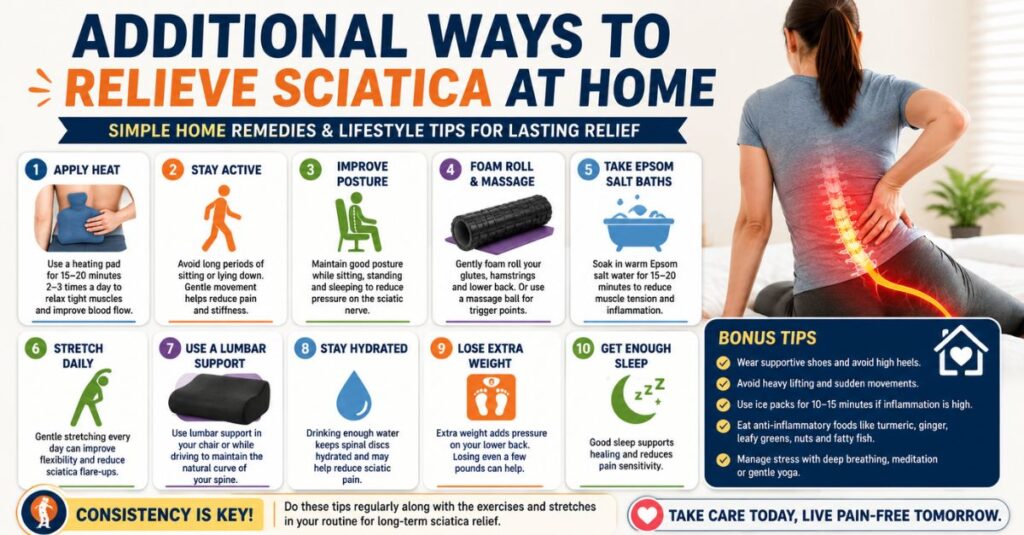
Exercise is only part of the picture. Sciatica Pain Relief in 10 Minutes: 12 Fast Exercises and Stretches That Actually Work Several other habits support sciatica treatment at home and speed up recovery. Combining movement with these methods often brings faster, longer-lasting comfort than exercise alone.
Many people also find relief through simple daily tools, like ice packs, short walks, and better sleep positions. The table below sums up quick options and when to use each one.
| Method | Best For | How Long It Takes |
| Ice therapy | Fresh flare-ups, swelling | 15–20 minutes |
| Heat therapy | Stiff, chronic tightness | 15–20 minutes |
| Short walks | General stiffness | 10–15 minutes |
| Swimming | Full-body low-impact relief | 20–30 minutes |
| Massage | Muscle knots and tension | 10–20 minutes |
| Acupuncture | Chronic, recurring pain | 30–45 minutes |
Apply Ice or Heat Therapy
Heat or ice for sciatica depends on your stage of pain. Ice works best in the first day or two, since it lowers swelling and numbs sharp pain. Heat works better for ongoing stiffness, since it relaxes tight muscles and boosts blood flow.
Some people switch between the two for the best result. Sciatica Pain Relief in 10 Minutes: 12 Fast Exercises and Stretches That Actually Work Never apply either one directly to bare skin for more than twenty minutes at a time.
Take Short Walks
Walking with sciatica feels scary at first, but gentle movement usually helps more than rest. Walking increases blood flow and keeps muscles from stiffening up further. A slow pace for ten to fifteen minutes is often enough to feel a difference.
Avoid long walks or fast paces during a sharp flare-up. Build up distance gradually as your pain improves.
Read More About: I’m Pregnant. Are Nivea Products Safe Compared to Burt’s Bees or Mustela? (2026 Guide)
Try Low-Impact Exercise
Yoga, stationary cycling, and gentle strength training count as best exercise for lower back pain without high impact. These options build strength and flexibility without jarring your spine or hips.
High-impact workouts like running should wait until your pain settles. Low-impact options let you stay active without risking a setback.
Swimming for Sciatica Relief
Water takes weight off your spine, which makes swimming a great option for sciatica. The buoyancy supports your body while you move, easing pressure on the compressed nerve.
Even a short swim session can loosen tight muscles. Some studies also suggest swimming may support nerve healing over time.
Massage Therapy
Massage targets muscle knots that build up around the hips, glutes, and lower back.Sciatica Pain Relief in 10 Minutes: 12 Fast Exercises and Stretches That Actually Work A professional deep tissue massage often brings strong relief, but self-massage tools work too.
A foam roller, massage gun, or even a tennis ball pressed against tight spots can ease tension between professional sessions.
Acupuncture
Acupuncture involves inserting thin needles at specific points on the body. Some research shows it can reduce pain by triggering the release of natural pain-fighting chemicals in the brain.
Results vary by person. Multiple sessions are usually needed before people notice a lasting change.
Over-the-Counter Pain Relievers
NSAIDs like ibuprofen reduce inflammation, while acetaminophen targets pain signals directly. Both can offer short-term comfort during a flare-up.
These medications don’t fix the underlying cause. Talk to a pharmacist or doctor if you need them regularly, since long-term use carries its own risks.
Daily Habits That Help Prevent Sciatica Flare-Ups
Preventing sciatica matters just as much as treating it. Sciatica Pain Relief in 10 Minutes: 12 Fast Exercises and Stretches That Actually Work Small daily changes protect your spine and lower your risk of a repeat flare-up. These habits work alongside any non-invasive sciatica treatment plan your doctor recommends.
Building better habits takes time, but the payoff is fewer flare-ups and less pain overall. Focus on consistency rather than perfection, and your spine will thank you.
Improve Sitting Posture
Sit with your feet flat on the floor and your back supported. Avoid slouching forward, since this adds pressure to your lower spine and the discs around it.
Stand up and move every thirty minutes if you work at a desk. Small breaks reduce the constant pressure that builds up from long sitting sessions.
Lift Heavy Objects Safely
Bend at your knees, not your waist, when picking things up. Keep the object close to your body and engage your core as you lift.
Twisting while lifting is one of the most common ways people injure their back. Turn your whole body instead of twisting your spine alone.
Strengthen Your Core
A strong core supports your spine during every movement you make. To strengthen core muscles, focus on exercises like planks, bridges, and bird dogs a few times each week.
Weak core muscles force your lower back to do extra work. Building strength here protects against future sciatica episodes.
Maintain a Healthy Weight
Extra weight adds pressure to your spine and the discs that cushion it. Losing even a small amount of weight can ease strain on the lower back significantly.
Combine gentle exercise with a balanced diet for the best results. This approach supports improved spinal flexibility goals too, since lighter movement is easier on stiff joints.
Stretch Every Day
Daily stretching keeps muscles loose and prevents the tightness that often leads to flare-ups. Sciatica Pain Relief in 10 Minutes: 12 Fast Exercises and Stretches That Actually Work Even five minutes each morning makes a real difference over time.
Consistency matters more than intensity here. A short daily routine beats an occasional long session every time.
Read More About:66 I Have Sensitive Skin. How Gentle Are Nivea’s Creams Compared to Aveeno?
Exercises and Activities to Avoid During Sciatica
Some movements can make sciatica worse. Knowing what to skip is just as important as knowing what to do. Avoiding these activities protects your sacroiliac joint dysfunction and disc-related pain from getting worse.
The table below lists common activities to avoid and why they can cause problems during a flare-up.
| Activity | Why It Hurts |
| High-impact activities | Jarring motion increases nerve pressure |
| Heavy lifting | Adds direct strain to lower spine discs |
| Prolonged sitting | Raises pressure on spinal discs |
| Twisting movements | Can aggravate disc-related sciatica |
High-Impact Activities
Running, jumping, and contact sports create sudden shocks through your spine. Sciatica Pain Relief in 10 Minutes: 12 Fast Exercises and Stretches That Actually Work These jarring movements can worsen nerve irritation and slow down healing.
Switch to low-impact options until your symptoms fully settle. Return to higher-impact activities gradually once you feel steady improvement.
Heavy Lifting
Lifting heavy objects adds direct pressure to your spinal discs. This is especially risky if a disc problem is already causing your sciatica.
Ask for help with heavy items during a flare-up. When you must lift, always use safe lifting form as described earlier.
Prolonged Sitting
Sitting increases pressure on spinal discs more than standing or lying down. Long car rides or desk sessions without breaks often make sciatica worse.
Set a timer to remind yourself to stand and move every thirty minutes. Small, frequent breaks protect your spine throughout the day.
Twisting Movements
Sudden or forceful twisting can shift pressure onto an already irritated nerve. Golf swings, certain yoga poses, and quick turning motions all carry this risk.
Move slowly and mindfully during any activity that involves rotation. Sciatica Pain Relief in 10 Minutes: 12 Fast Exercises and Stretches That Actually Work Build core strength to better support your spine during these movements.
When Sciatica Requires Medical Treatment
Home care solves many cases of sciatica, but not all. When pain doesn’t improve, medical treatment becomes the next step. A doctor can guide you toward the right level of care based on your specific cause.
Physical therapy for sciatica is often the first recommendation, since it addresses the root problem rather than just the pain itself. More advanced options exist for cases that don’t respond to conservative care.
Physical Therapy
A physical therapist builds a plan tailored to your specific cause and symptoms. This often includes targeted stretches, strength work, and hands-on techniques like the muscle energy technique.
Sessions usually continue for several weeks. Many people see steady improvement as their rehabilitation program progresses.
Prescription Medications
Doctors may prescribe muscle relaxants for severe muscle spasms. Nerve pain medications, like gabapentin, target the nerve pain directly rather than general inflammation.
Short-term opioids are sometimes used for severe pain, though doctors avoid long-term use due to dependence risks. Always follow your doctor’s exact instructions with these medications.
Steroid Injections
An epidural steroid injection delivers medication directly to the area around the irritated nerve. This can bring fast, significant relief for some patients.
Relief often lasts several weeks to months. Injections don’t fix the underlying cause, so they’re often paired with physical therapy for lasting results.
Surgery (When It’s Necessary)
Surgery is usually a last resort, reserved for severe or long-lasting cases.Sciatica Pain Relief in 10 Minutes: 12 Fast Exercises and Stretches That Actually Work A discectomy removes the part of a disc pressing on the nerve, while a laminectomy creates more space around the spinal cord.
Doctors typically recommend surgery only after conservative treatments fail, or when serious symptoms like muscle weakness or loss of bladder control appear.
Frequently Asked Questions
What is the fastest way to relieve sciatica pain?
Gentle stretches like the piriformis stretch and knee-to-chest stretch often bring relief within minutes. Applying ice can also calm sharp pain quickly during a fresh flare-up.
Can stretching make sciatica worse?
Yes, if done too aggressively. Move slowly and stop any stretch that causes sharp pain or increased numbness, since gentle movement should never feel intensely painful.
Is walking good for sciatica?
Yes, in most cases. Walking with sciatica at a slow, steady pace improves blood flow and prevents stiffness, though you should avoid long or fast walks during a sharp flare-up.
Should I use heat or ice for sciatica?
Use ice for the first day or two of a fresh flare-up to reduce swelling. Switch to heat afterward to relax tight muscles and improve blood flow.
How long does a sciatica flare-up last?
Most flare-ups improve within four to six weeks with proper care. Chronic sciatica can last longer and often needs a full evaluation from a doctor.
Can I exercise every day with sciatica?
Yes, gentle daily movement usually helps more than rest. Avoid high-impact or heavy exercise during a flare-up, and focus on the low-impact routine outlined in this article.
conclusion
Sciatica pain is frustrating, but fast relief is often within reach. A 10-minute sciatica workout, paired with smart daily habits, can ease pain and support long-term sciatica recovery tips. Consistency matters more than any single exercise.
If your pain lasts beyond a few weeks or comes with weakness or numbness, don’t wait to get checked out.Sciatica Pain Relief in 10 Minutes: 12 Fast Exercises and Stretches That Actually Work A doctor or physical therapist can build a personalized plan and rule out anything serious, so you can get back to moving freely and living pain-free.